Quiet Time

Quiet Time is unhurried, focused time set apart to meet with God so that your relationship with Jesus can deepen and grow. It is a simple daily rhythm where you give God your attention through practices like prayer, Scripture, and worship in a way that fits how He wired you.
Quiet Time Overview
Quiet Time is a foundational Christian practice built around being intentionally present with God, not just learning about Him. It is less about following a rigid formula and more about creating space in your schedule and heart to listen, respond, and walk closely with Jesus.
Relationship
Like a healthy marriage, a close walk with God does not stay vibrant by accident but grows as you invest time, attention, and skill into the relationship. When believers feel distant from God after an initial season of excitement, learning how to spend quality, consistent time with Him often restores a sense of intimacy and joy.
Core Practices in Quiet Time
Most Quiet Times center on three main practices: prayer (talking honestly with God), reading the Bible (listening to God’s voice through Scripture), and worship (responding to God with love, praise, and surrender). These can be arranged in any order and combined with other practices—such as journaling, silence, or reflection—so that your time with God is both meaningful and sustainable.
Biblical Foundation for Quiet Time
Quiet Time is grounded in Jesus’ own teaching on prayer and His example of slipping away to be alone with the Father. Prayer, Scripture, and worship are not modern ideas but core biblical ways God’s people have always drawn near to Him.
Jesus’s Teaching on Prayer
Quiet Time derives its name from Jesus's teaching in Matthew 6:5-13:
5 “And when you pray, do not be like the hypocrites, for they love to pray standing in the synagogues and on the street corners to be seen by others. Truly I tell you, they have received their reward in full. 6 But when you pray, go into your room, close the door and pray to your Father, who is unseen. Then your Father, who sees what is done in secret, will reward you. 7 And when you pray, do not keep on babbling like pagans, for they think they will be heard because of their many words. 8 Do not be like them, for your Father knows what you need before you ask him.
9 “This, then, is how you should pray:
“ ‘Our Father in heaven,
hallowed be your name,
10 your kingdom come,
your will be done,
on earth as it is in heaven.
11 Give us today our daily bread.
12 And forgive us our debts,
as we also have forgiven our debtors.
13 And lead us not into temptation,
but deliver us from the evil one.’
In this passage Jesus calls His followers away from performance and into sincere, hidden fellowship with the Father, which is the heart of Quiet Time.
Jesus's Prayer Life
The first and central Quiet Time practice is prayer, and Jesus not only taught on prayer but modeled it consistently. The Gospels show Him seeking solitary places, away from crowds and even His closest friends, to meet with the Father.
“Very early in the morning, while it was still dark, Jesus got up, left the house and went off to a solitary place, where he prayed.” - Mark 1:35
“But Jesus often withdrew to lonely places and prayed.” - Luke 5:16
“After he had dismissed them, he went up on a mountainside by himself to pray.” - Matthew 14:23
These verses show that unhurried, focused time alone with God was a regular rhythm in Jesus’ life, not a rare emergency measure. Quiet Time follows this same pattern: intentionally withdrawing from distractions to be with the Father in prayer, soaking in His Word, and responding with worship.
How to Do Quiet Time
Journey of the Heart is an eight-step Bible journaling method that helps you practice Quiet Time in a focused, repeatable way. It weaves together the core principles of Quiet Time—a quiet place, a regular routine, intentional scheduling, and journaling—so you can grow in knowing and loving Jesus over time.
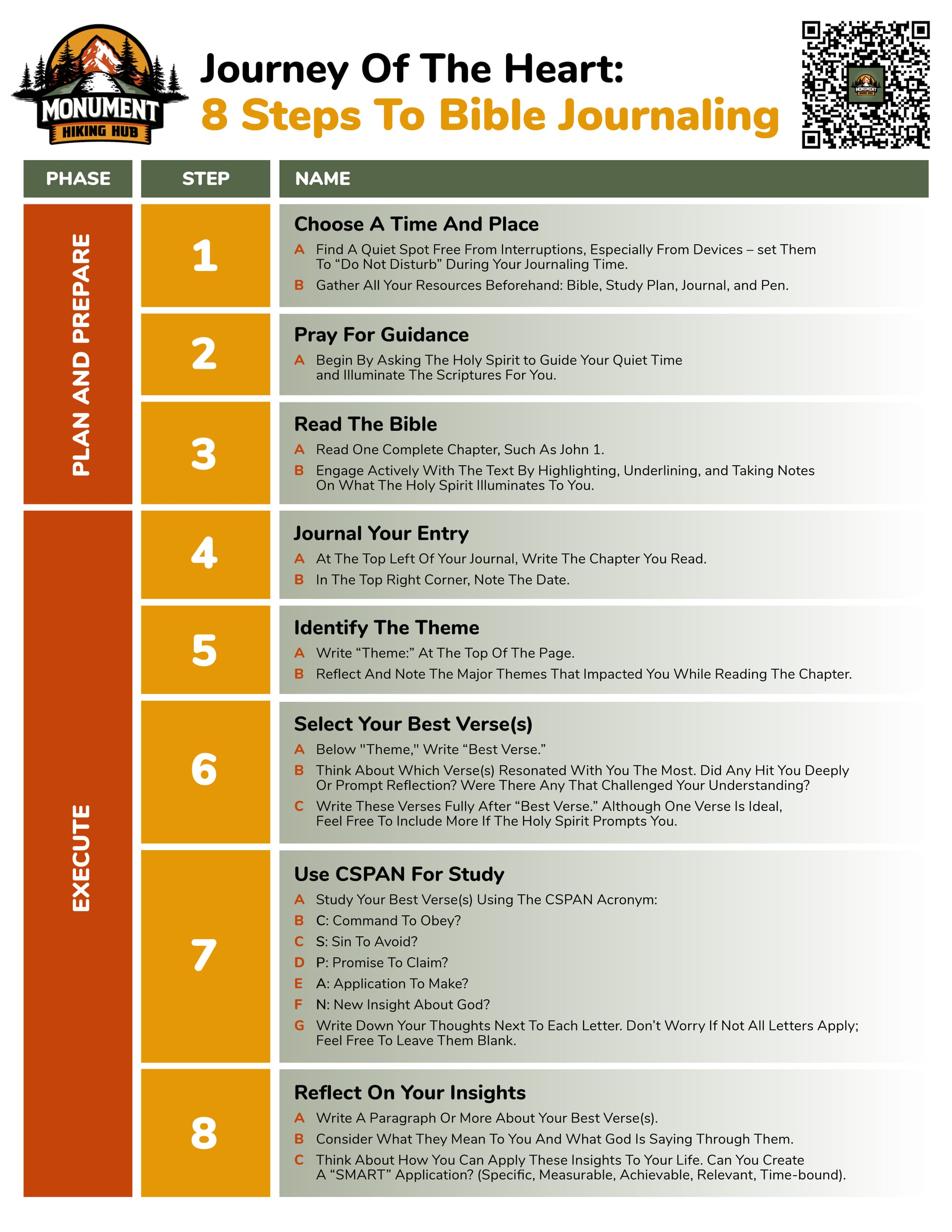
Step 1: Choose a Time and Place
Set aside a specific time and a quiet location that is as free from distractions as possible so you can focus on God. This might be a home office, a spot outdoors, a corner of a coffee shop, or anywhere you can reasonably expect minimal interruptions, and you gather your Bible, journal, and pen before you begin.
Step 2: Pray for Guidance
Begin your Quiet Time by asking the Holy Spirit to guide you and to open your heart and mind to Scripture. This simple prayer of dependence sets the tone that Quiet Time is relational, not just intellectual, and invites God to speak as you read and write.
Step 3: Read the Bible
Read one full chapter of the Bible, such as John 1, rather than jumping randomly between verses. As you read, engage actively with the text by underlining, highlighting, or jotting brief notes about phrases, commands, promises, or questions that stand out.
Step 4: Journal your Entry
At the top left of your journal page, write the chapter you read, and in the top right corner, write the date. This habit not only keeps your notes organized but also allows you, over time, to look back and see how God has met you through His Word on specific days and in different seasons.
Step 5: Identify the Theme
Next, write “Theme:” at the top of the page and summarize the main ideas or emphases that impacted you from the chapter. This step helps you move from scattered observations to a clearer sense of what God is highlighting in that passage for your heart and life.
Step 6: Select your Best Verse(s)
Underneath “Theme,” write “Best Verse” and choose the verse or verses that resonated with you most deeply. Consider which lines challenged you, encouraged you, or prompted reflection, and then copy those verses in full in your journal, allowing for more than one if the Holy Spirit prompts you.
Step 7: Use CSPAN for Study
Study your chosen verse(s) using the CSPAN acronym:
C – Command to obey
S – Sin to avoid
P – Promise to claim
A – Application to make
N – New insight about God
Write brief notes next to each letter that applies, without forcing answers where there are none, so you can move from merely observing the text to responding to it personally.
Step 8: Reflect on your Insights
Finally, write a paragraph or more reflecting on what your best verse(s) mean to you and what you sense God saying through them. Think through how you can live this out in a concrete way—ideally forming a “SMART” application (Specific, Measurable, Achievable, Relevant, Time-bound)—so your Quiet Time shapes real decisions, habits, and relationships.
This journaling method aligns with the principles of Quiet Time by giving you a quiet, scheduled, and repeatable way to meet with Jesus and record what He is teaching you. Over weeks and months, your journal becomes a record of your walk with God that you can revisit to remember His faithfulness and guidance.